The IMPACT Magazine Volume 2
Hosting in Canada's Subarctic
What happens when a tourism company takes its responsibility to place seriously? Frontiers North, a Certified B Corporation, has been working alongside the Churchill community for more than 40 years.
By Izabela Jaroszynski
Scroll down to read
Estimated read time: 4 minutes ↓
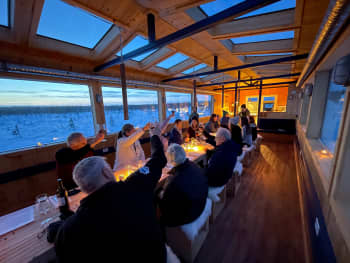
"Above all, we are hosts."
John Gunter doesn't offer the phrase as a marketing slogan. He uses it to explain the culture of Frontiers North Adventures and his own philosophy of tourism.
Long before Frontiers North became one of Canada's best-known northern tourism companies, employing more than 150 people and welcoming travellers from around the world to Churchill, Manitoba, it was a small family business operating from the basement of the Gunter family home in Winnipeg.
John remembers often falling asleep to the whir of the vacuum cleaner as his parents, Lynda and Merv Gunter, prepared to host family or friends passing through Winnipeg on their way to or from Churchill.
"Frontiers North was really built around hosting and about sharing what's going on in this really cool community with people from all over," he says. "This notion or this idea of hosting is just really baked into the company."
↓
Over the years, that instinct to host evolved into something broader.
As Frontiers North grew alongside Churchill's tourism industry, John found himself thinking less about the visitor experience alone and more about the company's role within the community itself.
Today, he describes the company's purpose as "to share in the stewardship of the communities and environments in which we operate".
That wording is intentional. When the company was refining its purpose statement, John initially wanted it to be simpler: we are stewards.
But he got challenged on that, with others making the point that stewardship is not exclusive to one company.
The broader purpose statement reflects the belief and understanding that stewardship is shared among residents, businesses, Indigenous partners, community organizations, and visitors alike.
↓
Churchill, which sits on the edge of Hudson Bay in northern Manitoba, is best known as one of the only places in the world where visitors can see polar bears up close. It also sits directly under the Auroral Oval, and hosts thousands of beluga whales in the Churchill River estuary each year. A triple tourism draw that has put Churchill on the international map.
But when his parents first started Frontiers North, they weren't focused on polar bears or northern lights or belugas — they just really loved the community and its people and wanted to help others visit safely and responsibly.
John spent four years of his childhood in Churchill when his dad's company transferred the family there in the early 1980s. He remembers a 'rough-and-tumble northern town' with kind and resilient people.
"It was really impressed upon me that around every dark corner could be lurking the world's largest land-roving carnivore, and you've got to be careful," he said.
Riding your bike up on the rocks surrounding town was "taking your life in your hands."
These early memories bred a respect for land and for the connection of the natural world.
↓

That philosophy has shaped how Frontiers North has grown.
For many years, the company relied only on a short polar bear season. Expanding into beluga whale experiences and northern lights tourism was not simply about attracting more visitors. Longer seasons created the stability needed to invest in accommodations, restaurants and community spaces while supporting more meaningful employment opportunities in Churchill.
"People in Churchill want to work in tourism, but they don't want a gig," Gunter says. "They want a career."
Today, Frontiers North operates restaurants, hospitality spaces and a growing portfolio of tourism experiences.
Tourism infrastructure, he says, serves a dual purpose. It creates memorable experiences for visitors while also supporting jobs, gathering spaces and opportunities for the people who call Churchill home.
That same sense of responsibility extends to how the company measures its impact. Long before sustainability certifications became commonplace in tourism, Frontiers North was producing corporate social responsibility reports and looking for ways to evaluate its performance beyond financial results.
The company later became a certified B Corporation, a designation John values not because of the label itself, but because of the accountability behind it.
"It's not a self-proclamation," he says. "It's somebody else putting us through the meat grinder and giving us a pass or fail."
It provides an independent measure of whether the company is living up to its commitments to community, environment and employees.
↓
A belief in the good that tourism can do is a big part of why John continues to remain involved with the IMPACT community.
Over the years, he has attended the conference as a participant, speaker and award recipient. Yet when asked why he continues to support IMPACT, he gently reframes the question.
"You've termed it or you've phrased it that we're showing up to support," he says. "But I feel like we're the ones getting the support."
John Gunter receiving the IMPACT Award in 2024
John Gunter receiving the IMPACT Award in 2024
For John, the value lies in the relationships and the opportunity to learn from others. More than a dozen members of the Frontiers North team have attended IMPACT over the years, bringing back new ideas and perspectives.
"It can't just be me that goes every year, we need new eyes," he says. "We need new perspectives coming back and germinating great ideas within the company."
It is a fitting perspective from someone who has spent much of his career expanding the idea of what tourism can be.
What began as hosting has grown into stewardship. What began as welcoming visitors has become a broader responsibility to community, place and future generations.
The scale of Frontiers North has changed dramatically over the past four decades. The responsibility, John would argue, has grown with it.
⎯